
PCIe Interconnection Technology Analysis: Evolution and Differences of CEM Riser Cable and CEM Riser
1. CEM Riser Cable
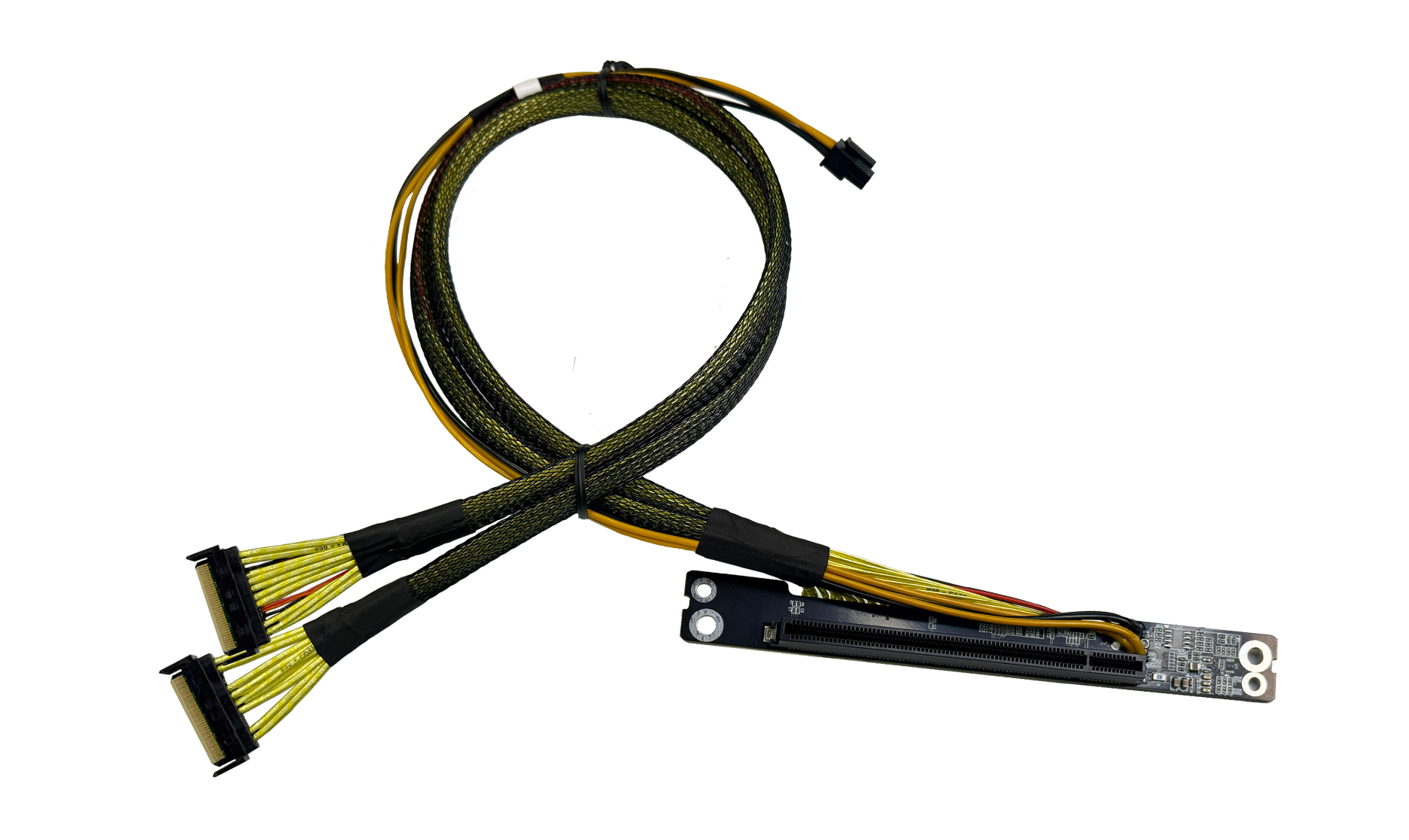
A CEM Riser Cable is a flexible interconnect solution based on high-performance Twinax cables. One end is typically equipped with a standard CEM slot (receptacle), while the other end connects to high-density interfaces on the motherboard depending on the system architecture.
In the latest industry practices (especially in the PCIe 5.0/6.0 era), the motherboard side typically utilizes new high-speed interfaces such as MCIO (Mini Cool Edge IO, SFF-TA-1016), Gen-Z (SFF-TA-1002), or SlimSAS (SFF-8654), replacing the earlier SFF-8639/SFF-8643 standards.
Core Features:
- Ultimate High-Speed Signal Integrity (Over-the-Board Architecture): At the extreme frequencies of PCIe 5.0/6.0, signal attenuation on traditional motherboard PCBs is exceptionally severe. CEM Riser Cables employ an "Over-the-Board" approach, allowing signals to bypass the motherboard PCB and transmit directly through the cable. Its insertion loss is typically only 1/5 or less of that of high-end PCB traces, making it crucial for long-distance lossless transmission.
- High Architectural Flexibility: The flexibility of the cables frees hardware engineers from the constraints of a two-dimensional motherboard layout. It can easily bridge over heatsinks and memory slots, connecting to EDSFF NVMe backplanes at the front of the chassis or specific expansion zones at the rear.
- Optimized Cooling Airflow: In high-density AI servers, replacing large-area PCB adapter boards with thin-gauge high-speed cables effectively reduces airflow blockage, thereby improving overall system cooling efficiency.
2. CEM Riser (Expansion Board)
A CEM Riser (commonly referred to as a Riser Card or adapter/expansion card) is a physical expansion solution based on a rigid PCB (Printed Circuit Board). Its core function is to redirect the PCIe slot on the motherboard (e.g., a 90-degree turn) or translate it to another physical location to accommodate the height limits of 1U/2U servers or compact chassis.
Core Features:
- Spatial Form Conversion: It is the foundational component for implementing the "horizontal installation" of full-height/half-height PCIe devices (such as heavy GPU cards or SmartNICs) within a server. Common structural designs include the "Butterfly" configuration.
- High Mechanical Strength and Stability: Compared to cables, a CEM Riser consists of multi-layer rigid PCBs and reinforced gold finger connections, providing excellent physical support and shock resistance for heavy expansion cards.
- Facing Signal Attenuation and Cost Challenges: Because signals must pass through gold fingers, connectors, and PCB traces, CEM Risers introduce higher insertion loss at PCIe 5.0 and higher speeds. To meet signal integrity requirements, modern high-speed riser cards must utilize extremely expensive ultra-low-loss board materials (such as Megtron 6/7) or incorporate additional Retimer/Redriver chips on the board to recover the signal, which significantly increases design costs.
3. Core Differences Comparison and Selection Guide
| Comparison Dimension | CEM Riser Cable | CEM Riser (Expansion Board) |
|---|---|---|
| Physical Structure | Flexible Twinax Cable + Connectors | Rigid Multi-layer PCB + Gold Fingers + Slots |
| Signal Integrity (SI) | Extremely Low Loss. Ideal for long-distance high-speed direct connections (Preferred for PCIe 5.0/6.0). | Higher Loss. Long-distance transmission requires expensive PCB materials or active Retimer chips. |
| Space & Flexibility | Extremely High. Can route freely around obstacles with versatile interface conversions (e.g., MCIO/SlimSAS to CEM). | Limited. Can only extend rigidly along fixed 3D coordinates (e.g., 90-degree angle). |
| Mechanical Support | Weaker. Requires additional mounting brackets from the chassis to support the plugged-in PCIe devices. | Extremely Strong. The board itself serves as a stable load-bearing platform for devices. |
| Typical Applications | Internal GPU interconnects in AI servers, high-density NVMe storage backplanes, Composable Infrastructure. | Standard 1U/2U rack servers, traditional IT nodes requiring horizontally mounted NICs/accelerators. |
Industry Trend Summary: With the rapid surge in computing density, modern high-end servers (such as NVIDIA MGX/HGX architectures or OCP-specified servers) frequently adopt a "Hybrid Architecture": placing MCIO interfaces on the motherboard, drawing out extreme-speed signals with low loss via CEM Riser Cables, connecting them to a small, reinforced CEM Riser fixed at a specific location in the chassis, and finally plugging in the GPU or NIC. This combination ensures the signal integrity required for PCIe 5.0/6.0 while simultaneously accommodating the mechanical stability needed for heavy expansion cards.